
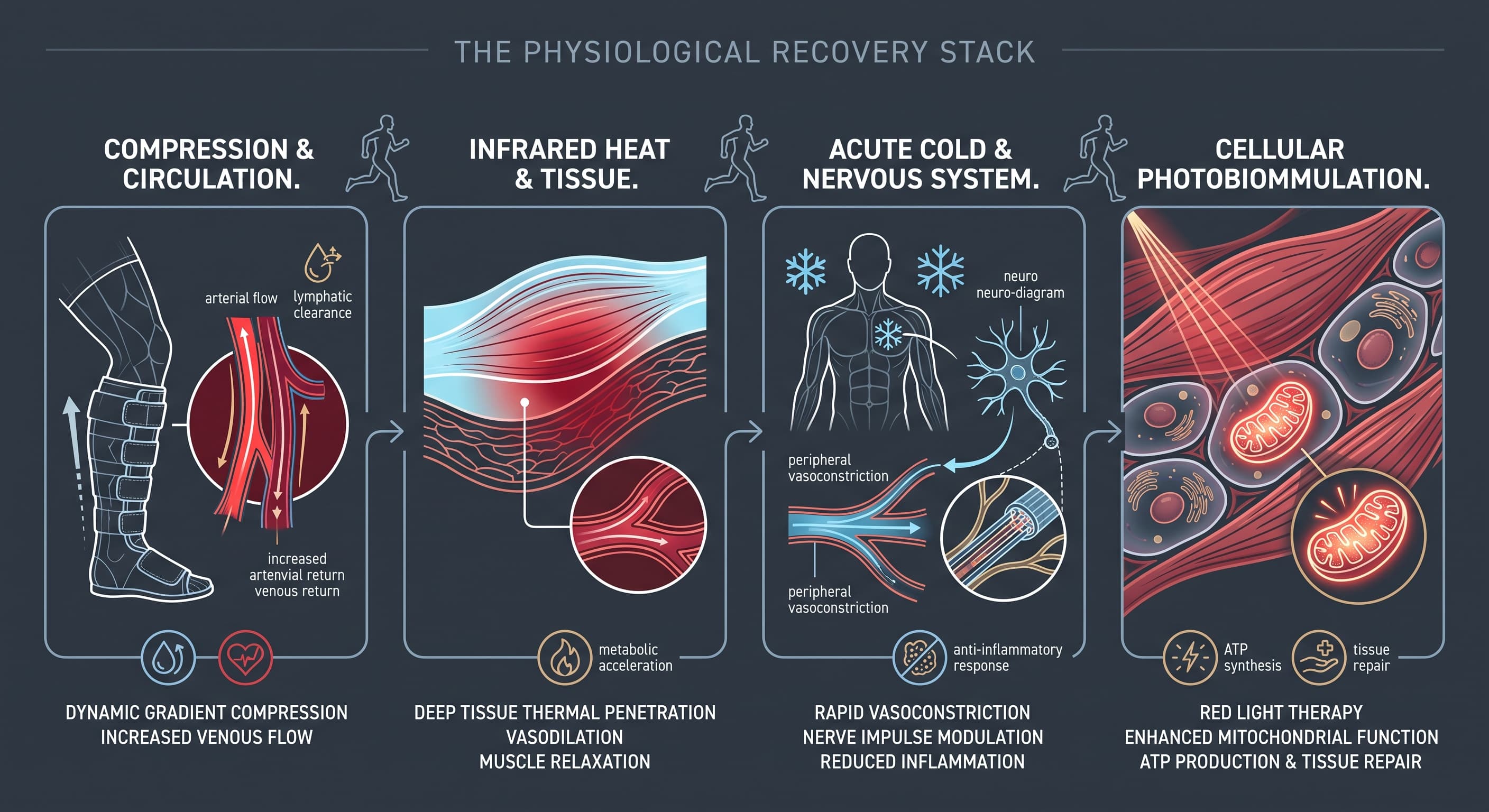
In health and athletic performance, training is only half of the adaptation equation. Stimuli like heavy lifting, high-intensity intervals, or prolonged endurance work create micro-tears in muscle fibers, elevate systemic inflammation, and place heavy demands on the central nervous system. Actual physical improvement—hypertrophy, cardiovascular endurance, mitochondrial density, and mental resilience—occurs entirely during the recovery phase.
Without deliberate recovery strategies, high training loads or chronic stress can outpace the body's repair capacity. Over time, this imbalance leads to persistent fatigue, compromised immune function, joint stiffness, and plateaued performance.
To optimize recovery, it is helpful to understand how different modalities target specific physiological systems—and why strategically stacking them can enhance the overall outcome.
The Physiology of Recovery
At its core, physical recovery relies on three major physiological processes:
- Circulatory & Lymphatic Clearance: Removing metabolic byproducts and mobile fluid accumulation (edema) from damaged tissues while delivering fresh oxygen and nutrients.
- Cellular Energy Restoration: Repairing damaged cell structures and replenishing intracellular energy stores (such as adenosine triphosphate, or ATP).
- Autonomic Nervous System Regulation: Transitioning from a sympathetic state ("fight or flight," driven by cortisol and adrenaline) back into a parasympathetic state ("rest and digest") to facilitate tissue synthesis and sleep.
Key Recovery Modalities and How They Work
Modern recovery protocols leverage temperature, pressure, and light to interface directly with human physiology.
1. Dynamic Compression Therapy
Pneumatic compression uses controlled, sequential air pressure applied to limbs (typically via boots or sleeves).
- Physiological Mechanism: The active gradient pulsing simulates the natural muscle pump mechanism, accelerating venous return and lymphatic drainage.
- Primary Role: Mobilizes pooled interstitial fluid, reduces delayed onset muscle soreness (DOMS), and improves lower-limb circulation without requiring muscular exertion.
2. Hyperthermic Conditioning (Infrared Sauna)
Unlike traditional hot-air saunas, infrared saunas emit light waves that directly penetrate skin and deep tissue, elevating core body temperature.
- Physiological Mechanism: Heat exposure induces widespread vasodilation (widening of blood vessels), increasing cardiac output and blood flow to peripheral tissues. It also triggers heat shock proteins (HSPs), which help protect cellular structures from oxidative stress and aid protein folding.
- Primary Role: Relaxes tight muscular tissue, promotes cardiovascular adaptation, lowers circulating stress hormones, and aids deep relaxation.
3. Acute Cryotherapy (Cold Exposure)
Whole-body cryotherapy or cold water immersion exposes the body to extreme ambient cold for brief periods (typically 2 to 3 minutes).
- Physiological Mechanism: Cold triggers rapid vasoconstriction (narrowing of blood vessels) and a rush of peripheral blood toward core organs. Upon exiting the cold environment, a rapid reperfusion of oxygenated blood floods back into the extremities. Cold exposure also triggers an immediate neurochemical response, increasing norepinephrine and dopamine.
- Primary Role: Blunts acute systemic inflammation, reduces pain signal transmission, and provides an immediate boost in mental alertness and mood.
4. Photobiomodulation (Red and Near-Infrared Light Therapy)
Red light therapy utilizes specific light wavelengths—typically in the red (630–660 nm) and near-infrared (810–850 nm) spectrums—to interact with deep tissue cells.
- Physiological Mechanism: Photons are absorbed by cytochrome c oxidase, a critical enzyme within cellular mitochondria. This interaction enhances the mitochondrial electron transport chain, boosting cellular ATP (energy) production and decreasing cellular oxidative stress.
- Primary Role: Accelerates tissue repair, supports collagen synthesis, reduces joint inflammation, and restores energy at the cellular level.
The Rationale for Sequencing and Stacking
While each modality delivers distinct physiological benefits in isolation, combining them sequentially leverages contrast therapy and biological priming to maximize efficiency.
       1. Dynamic Compression
                 │ (Flush stagnant fluid & prime circulation)
                 ▼
       2. Hyperthermic Conditioning (Infrared Heat)
                 │ (Dilate vessels & relax muscular tissue)
                 ▼
       3. Acute Cryotherapy (Cold Exposure)
                 │ (Trigger systemic vasoconstriction & anti-inflammatory response)
                 ▼
       4. Photobiomodulation (Red Light)
                 └─► (Stimulate ATP production in newly oxygenated cells)
By structuring a session in this sequence—starting with fluid clearance (compression), moving into deep tissue warming (infrared heat), following with a rapid cold stimulus (cryotherapy), and finishing with mitochondrial stimulation (red light)—the body undergoes a deliberate cycle of fluid mobilization, vessel expansion, acute contraction, and cellular feeding.
Conclusion: Making Recovery a Routine, Not an Afterthought
Effective recovery is not merely the absence of exercise; it is an active, structured discipline. Whether through basic sleep hygiene and contrast showers or structured multi-modal protocols, prioritizing recovery ensures that training stress results in adaptation rather than breakdown. Treating recovery as a non-negotiable part of your weekly routine is essential for maintaining physical performance, joint health, and long-term vitality.