
A lot can happen between doctor visits.
Your knee starts hurting after a run. You sleep badly for three nights. A new medication makes you feel different. Your energy drops for a week, then comes back. You get a recurring headache, but by the time your appointment arrives, you can’t quite remember when it started, how often it happened, or what else was going on at the time.
Then your doctor asks:
“So, how have you been feeling?”
And you try to reconstruct the last month from memory.
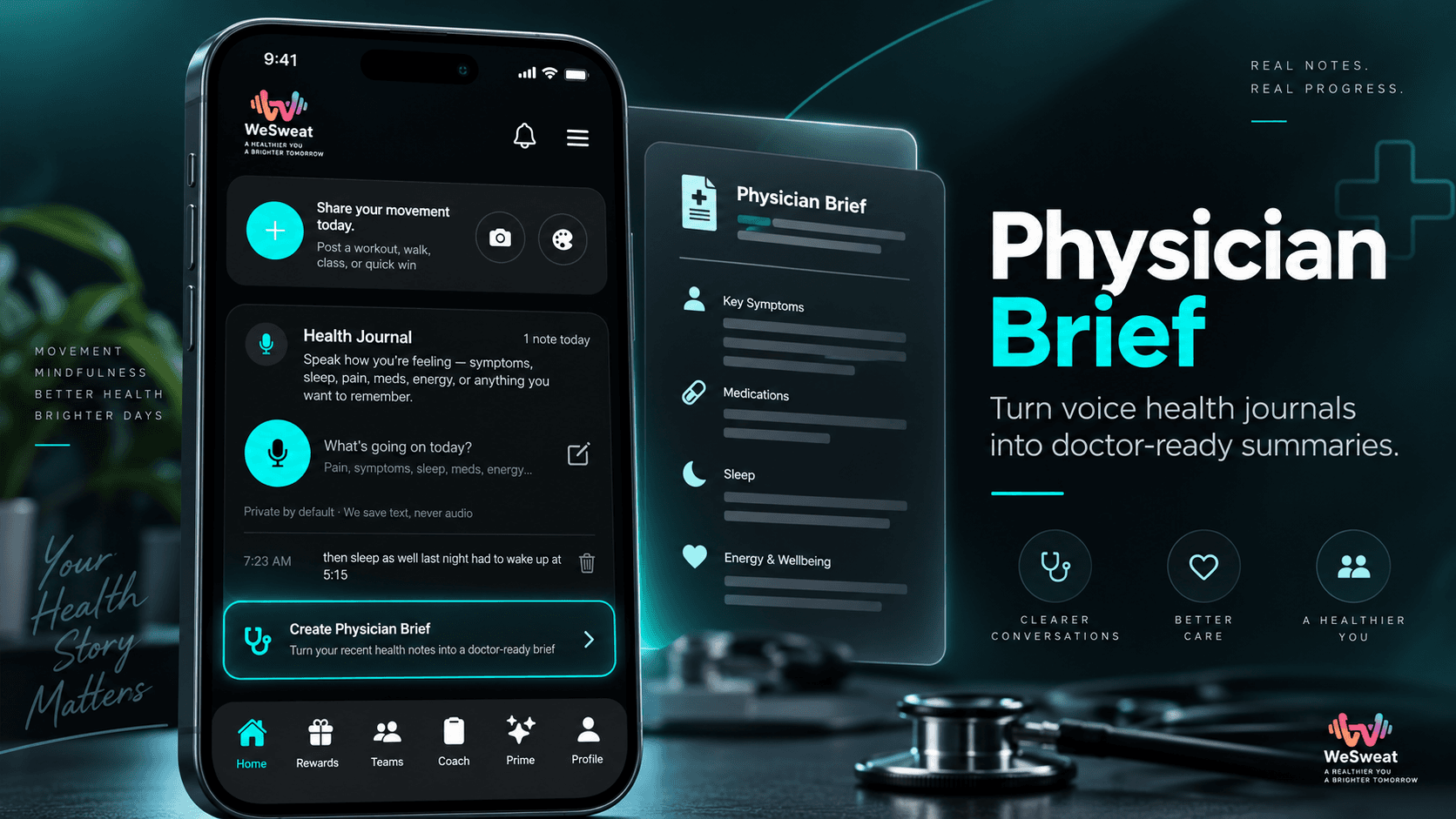
We built Physician Brief in WeSweat to make that easier.
With Physician Brief, you can quickly record what you’re experiencing as it happens—using your voice—and turn those observations into a concise health summary that you can review and choose to share with your physician.
Your health doesn’t only happen during appointments
Most medical visits capture a small snapshot in time.
But many of the things that matter to your health happen in the days and weeks between appointments:
- Pain that comes and goes
- Changes in sleep
- Fatigue or changes in energy
- Headaches
- Digestive symptoms
- Mood or stress changes
- Reactions after exercise
- Medication or supplement changes
- Changes in appetite
- Symptoms that seem to be improving—or getting worse
These details can be difficult to remember accurately weeks later.
You might remember that your back hurt, but not that it happened four times after long drives.
You might remember feeling unusually tired, but forget that it coincided with several nights of poor sleep.
You might remember that a medication “didn’t feel right,” but struggle to explain exactly what changed.
Physician Brief is designed to help you capture those details while they’re still fresh.
Speak it when it happens
Health journaling shouldn’t feel like filling out another form.
When something feels worth remembering, open WeSweat and talk.
You might say:
“My right knee is sore again today. It’s mostly when I walk downstairs. Probably a four out of ten.”
Or:
“I only slept about five hours last night and I feel exhausted today. This is the third night this week I’ve had trouble sleeping.”
Or simply:
“Started the new medication yesterday. Feeling a little lightheaded this afternoon.”
WeSweat converts your voice entry into text and saves the journal entry with its date.
No complicated symptom tracker. No long questionnaire. No trying to decide which category your experience belongs in before you record it.
Just describe what is going on.
Your journal is private by default, and WeSweat saves the text of your entry—not the audio recording.
From scattered notes to a Physician Brief
A journal becomes much more useful when you can see the bigger picture.
Over several weeks, your entries may contain dozens of individual observations. Reading through all of them before an appointment isn’t particularly helpful for you—or your doctor.
That’s where Physician Brief comes in.
WeSweat can organize your recent health journal into a concise, easy-to-review summary highlighting things such as:
- Key symptoms and concerns
- When they occurred
- Changes over time
- Recurring patterns
- Reported severity or frequency
- Changes in sleep, energy or daily activity
- Medication or supplement changes you recorded
- Topics you may want to discuss at your next visit
The goal isn’t to diagnose you.
It’s to help you walk into your appointment with a clearer record of what you experienced.
A better answer to “How have you been?”
Imagine you’ve logged a month of health observations.
Instead of trying to remember everything on the spot, you could arrive at your appointment with a brief that says, in effect:
Over the last 30 days:
- Right knee discomfort was mentioned on six separate days, primarily when walking downstairs or after running.
- Symptoms were described as mild to moderate and appeared to improve during the final week.
- Sleep disruption was reported on five nights and was accompanied by lower energy the following day.
- A new supplement was started midway through the month.
- Two episodes of headache occurred during the same period as poor sleep.
That doesn’t tell your physician what the diagnosis is.
It gives them something potentially more useful: a clearer history.
And good medical conversations often start with a good history.
Your observations, organized—not interpreted
There’s an important distinction behind how we designed Physician Brief.
WeSweat is not trying to replace your physician, diagnose medical conditions, or tell you what treatment you need.
The brief is intended to organize what you reported.
If you mention headaches after several nights of poor sleep, the brief may highlight that those things happened around the same time. It should not claim that poor sleep caused the headaches.
If you record knee pain six times, it can tell your physician when you reported it and how you described it. It should not decide what injury you have.
That distinction matters.
AI can be very useful for organizing weeks of unstructured information. Medical interpretation still belongs in the conversation between you and your healthcare professional.
Built for the moments that are easy to forget
Not every health observation needs to become a doctor visit.
Sometimes you simply want to remember what happened.
That is why the journal itself is useful even before you create a brief.
A quick voice note takes seconds:
“Headache again this afternoon.”
“Slept really well last night. Energy much better today.”
“Shoulder still hurts when I reach overhead.”
Individually, those observations might not mean much.
Over time, they create a better record of your experience.
And when it is time for your next appointment, Physician Brief can help make that record easier to use.
How Physician Brief works
Using the feature is simple:
- Speak it in the moment. Record symptoms, sleep, pain, medications, energy, mood or other changes you want to remember.
- Build your private health journal. Entries are saved as dated text so you can look back over time.
- Create your Physician Brief. Before an appointment, generate a concise summary of your recent journal.
- Review it first. Make sure the brief reflects what you experienced.
- Share it if you choose. Bring it to your physician as additional context for your conversation.
No pain gets left behind
We started building this feature around a simple problem:
People experience far more about their health than they can remember during a 15- or 30-minute medical visit.
Technology can help close that gap.
Not by replacing the physician.
Not by turning every symptom into a diagnosis.
But by helping people capture what happened, recognize what changed, and communicate it more clearly when it matters.
That’s what Physician Brief is designed to do.
Speak it when it happens. Keep track over time. Bring a clearer story to your next appointment.