
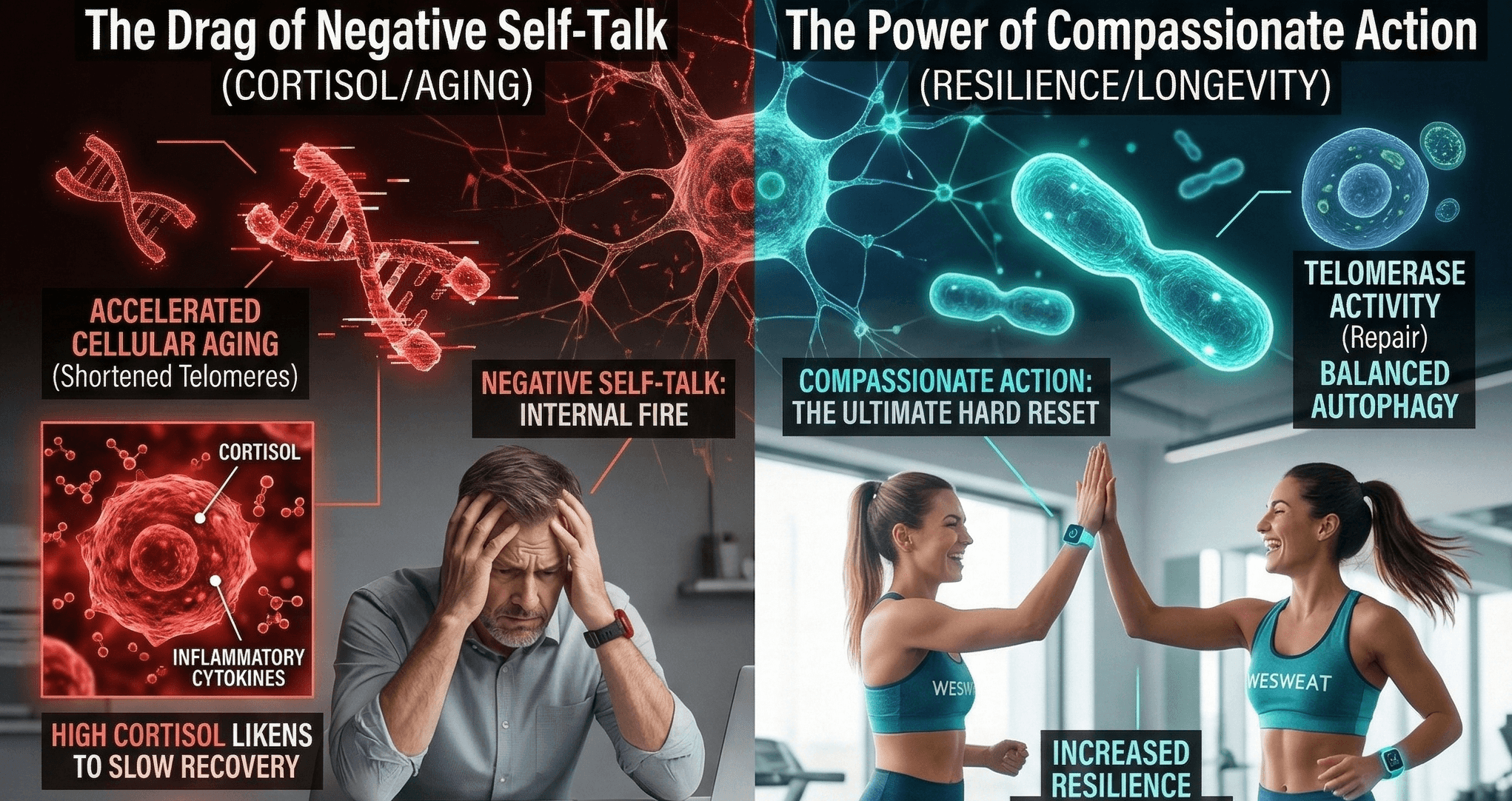
We’ve all been there. You miss a workout, you struggle with a heavy set, or you slip up on your nutrition, and that voice in your head starts: “I’m so lazy. I’m never going to reach my goals. I’m just a mess.”
At WeSweat, we talk a lot about the power of the community to keep us moving. But there is one partner you can’t escape: your inner monologue. New research suggests that this negative self-talk isn't just a "bad mood"—it is a biochemical signal that’s aging your cells in real-time.
The Science: When Thoughts Become Biological Threats
According to recent findings highlighted by RathBiotaClan, your brain doesn't distinguish between a physical predator and a harsh self-critique. Both trigger the HPA axis (your body’s central stress-response system).
When you trash-talk yourself, your hypothalamus signals your adrenal glands to flood your system with cortisol. This is great if you’re running from a lion, but it’s devastating when it’s chronic.
The high cost of a "Mental Rant":
-
Delayed Recovery: Research shows that individuals with repetitive negative thinking (RNT) don’t just feel more stressed; they recover slower. For the WeSweat community, this means your muscles and nervous system stay in a "breakdown" state longer after a workout.
-
Shortened Telomeres: Nobel laureate Elizabeth Blackburn’s research found that chronic stress and pessimism actually shorten telomeres—the protective caps on your DNA. Shorter telomeres are a direct marker of accelerated biological aging.
-
Inflammatory Spikes: Persistent self-criticism promotes the release of inflammatory cytokines. This "internal fire" is a primary driver of burnout and metabolic disorders.
Why Data is Your Best Defense
This is where your Garmin or Apple Watch becomes a mental health tool. Because negative self-talk is a physiological event, it leaves a "paper trail" in your data.
-
HRV (Heart Rate Variability): Negative rumination keeps your body in a "fight or flight" state, which causes your HRV to tank. If you notice your HRV is low despite a rest day, check your internal dialogue.
-
Resting Heart Rate (RHR): A spike in RHR can often be traced back to mental stress. If you’re beating yourself up over a missed session, your RHR will stay elevated, preventing the very recovery you need to get back at it tomorrow.
The WeSweat Strategy: Flip the Script
The good news? This process is reversible. Just as we train our glutes or our lungs, we can train our resilience.
-
Catch and Release: Use the "Notice, Challenge, Replace" method. Notice the thought ("I'm a failure for missing today"), challenge it with evidence ("I've hit 4 workouts this week"), and replace it ("I needed rest, and I'll be stronger tomorrow").
-
Leverage the Tribe: This is why social accountability works. When your inner critic is loud, lean on your WeSweat group. Often, a teammate’s encouragement can act as an external "off switch" for your stress response.
-
Focus on Recovery Data: Instead of obsessing over calories, look at your sleep and HRV. When you see the data improve because you chose self-compassion over self-criticism, it reinforces the habit.
The Bottom Line
Being "hard on yourself" isn't a badge of honor; it’s a biological burden. If you want to live longer, perform better, and stay in the game, you have to be as kind to your mind as you are to your body.
Your cells are listening. Give them something better to hear.
References for Further Reading:
- Brueckmann, M., et al. (2025). Repetitive negative thinking and burnout.
- Blackburn, E. H., & Epel, E. S. (2009). Telomeres and accelerated cellular aging.
- Daubenmier, J., et al. (2012). Mindfulness, stress, and telomerase activity.