
At WeSweat, our core philosophy revolves around the SPAN framework—optimizing Sleep, Physical Activity, and Nutrition to maximize human healthspan. While tracking daily step counts and protein metrics often take center stage, groundbreaking new science indicates that your sleep architecture might be the ultimate coordinator of how your internal organs age.
A landmark study published in Nature (May 2026) by researchers at Columbia University has completely re-engineered our understanding of rest. Using machine learning models trained on data from over half a million participants in the UK Biobank, scientists successfully built 23 specialized aging clocks across 17 distinct organ systems.
The verdict? Sleep is not just a brain-centric reset button. It is a body-wide coordination network, and both too little and too much sleep accelerate biological aging across almost every organ system.
The Dangerous "U-Curve" of Organ Aging
Historically, longevity research looked at biological aging as a whole-body metric. However, our internal systems don't age uniformly. Your liver, heart, immune system, and lungs each have their own biological clocks running at different speeds based on your lifestyle choices.
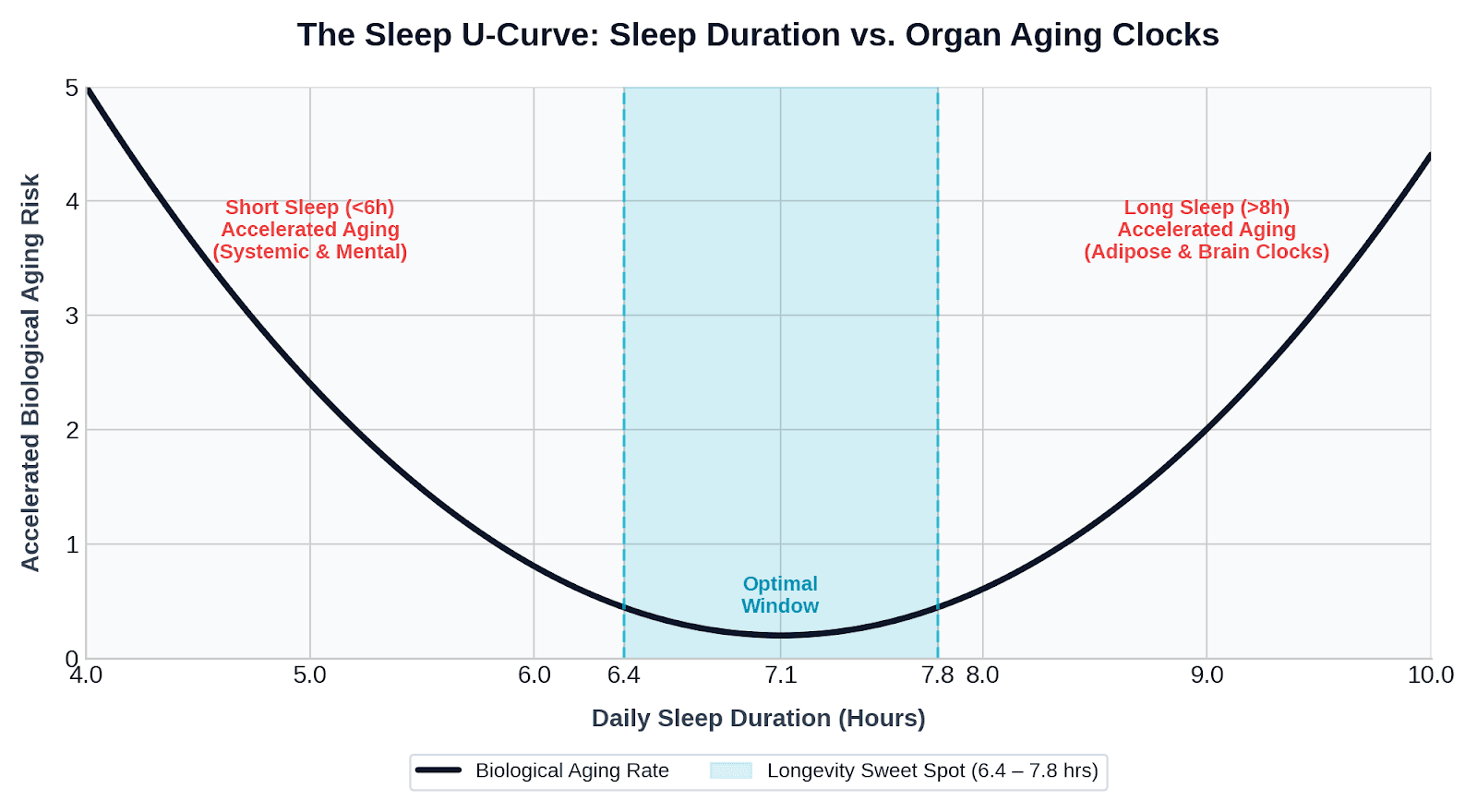
When analyzing how sleep duration interacts with these multi-omic organ clocks, a strict U-shaped pattern emerged:
- Short Sleep (< 6 hours): Strongly correlated with accelerated biological aging in the brain, heart, and immune system. Chronically short sleepers showed heightened systemic disease burden, including accelerated clocks for cardiovascular health (hypertension, ischemic heart disease) and metabolic health (type 2 diabetes, obesity).
- Long Sleep (> 8 hours): Counterintuitively, oversleeping is not protective. Excessive sleep was deeply linked to accelerated aging in the respiratory and digestive systems, as well as specific fat-tissue (adipose) clocks that drive systemic inflammation.
The Longevity Target: 6.4 to 7.8 Hours
The research pinpointed a highly precise "sweet spot" where biological organ aging is minimized: between 6.4 and 7.8 hours of sleep per day.
   Accelerated Aging Risk
     ^
     |     \               /  <-- Short & Long Sleep accelerate aging
     |      \             /
     |       \  6.4---7.8 //
     |        \_Sweet_Spot_/  <-- Lowest biological age gaps
     +----------------------------->
       4h   5h   6h   7h   8h   9h  10h
                  Sleep Duration
Within this optimal window, the brain-body network operates at peak metabolic and immune efficiency. Interestingly, the study noted that the biological pathways to decline differ between the two extremes. For instance, in tracking late-life depression, short sleep directly drives neural disease burden, while long sleep influences depression through a complex interplay between the brain and adipose (fat tissue) aging clocks.
Moving Beyond Chronological Age: Your WeSweat Digital Twin
This study perfectly underscores the power of the Digital Twin concept. By utilizing biometric and molecular data layers, we can digitize how many years an organ is aging relative to a person's actual chronological age.
You cannot manage what you do not measure. To keep your organ clocks ticking slower than the calendar, consistency is paramount.
Actionable Strategies for Your Sleep Routine:
- Ditch the Weekend "Catch-Up" Myth: Spending 10 hours in bed on Sundays cannot reverse the cellular aging of a high-stress, 5-hour sleep week. In fact, wild swings in sleep duration create circadian misalignment that accelerates your metabolic aging clocks. Aim for a consistent window inside the 6.4–7.8 hour range every single night.
- Leverage Your Wearable Data: Don’t just look at your morning recovery score on your Garmin or Apple Health app. Track your 7-day rolling average of sleep duration. Your goal is to keep that baseline steady within the optimal longevity window.
- Build High-Accountability Habits: Use the WeSweat public teams to commit to a wind-down routine. Social accountability is just as effective for sleep hygiene as it is for hitting your weekly workout minutes.
Your longevity isn’t determined by a future medical breakthrough; it’s engineered tonight when your head hits the pillow. Lock in your sleep target, protect your organ clocks, and let’s keep the streak alive.
References: Wen, J., et al. (2026). "Sleep chart of biological aging clocks in middle and late life." Nature. DOI:10.1038/s41586-026-10524-5
© 2026 WeSweat | SPAN Framework Insights