
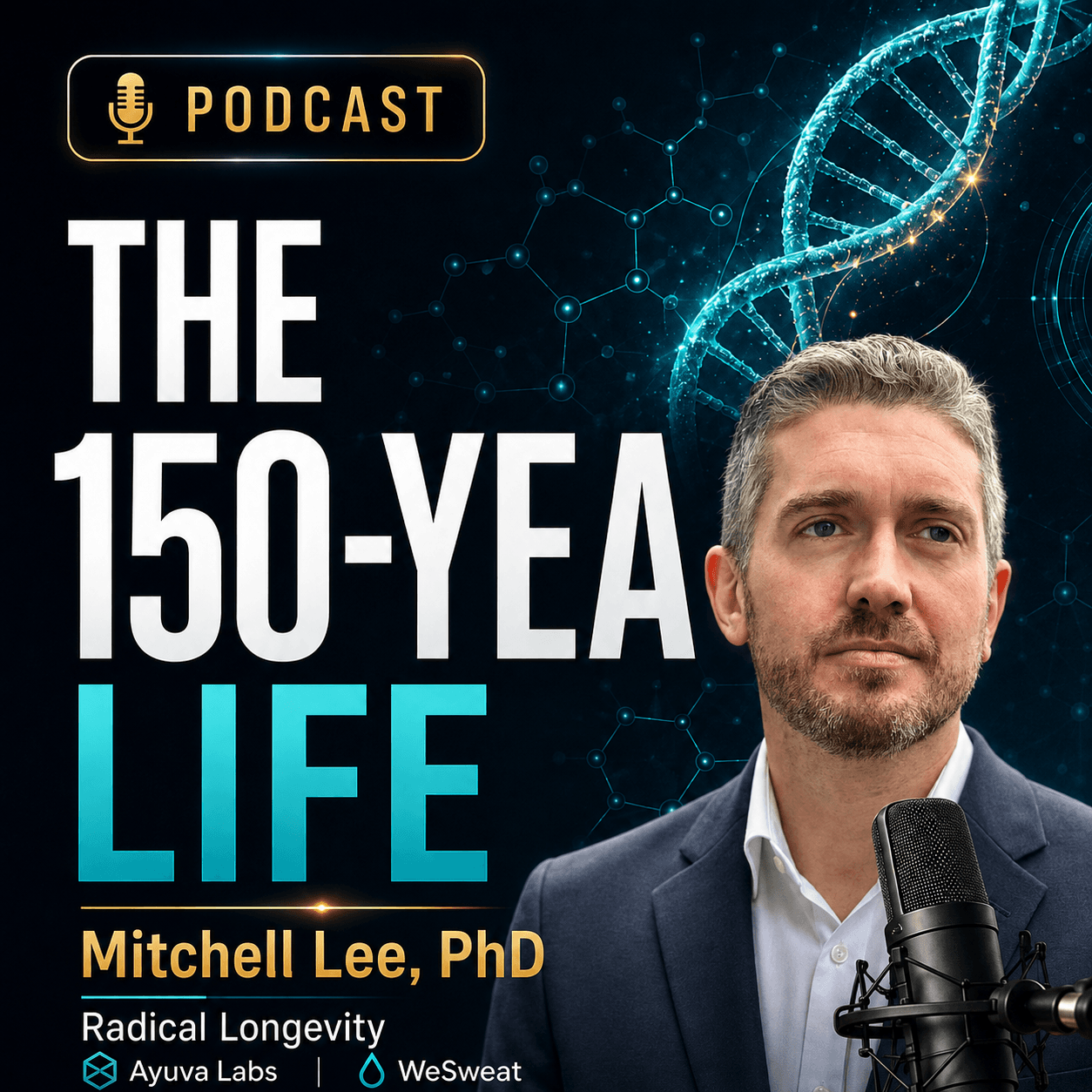
What if the first person to live to 150 years old is already alive today?
That’s the provocative question at the center of our latest conversation on Beyond the Plan, the Ayuva Labs podcast.
I sat down with Mitchell Lee, PhD, longevity scientist and author of the forthcoming The 150-Year Life: Launching the Era of Radical Longevity, to talk about what the science of aging actually tells us—and where the hype gets ahead of the evidence.
We explored:
• Why aging may be biologically modifiable rather than simply inevitable • The emerging field of geroscience and why aging itself may be upstream of many chronic diseases • Why claims about “reversing your biological age” deserve more scrutiny • What research on dietary restriction, mTOR and rapamycin actually shows • Why there may never be one longevity protocol that works for everyone • And the much more practical question: what can we do today to increase our chances of living longer, healthier lives?
One idea from the conversation particularly resonated with us at Ayuva Labs:
The future of longevity isn't just about discovering better interventions. It's also about helping people consistently act on what we already know.
Knowing the plan is only the beginning.
That’s what Beyond the Plan is about.
🎙️ Watch the full conversation: The 150 Year Life
Transcript
00:01.51 Prem Kuchi: Hello and welcome to Beyond the Plan. Today we're going to talk about a question that seems almost absurd the first time you hear about it. Could somebody alive today? lived to be 150 years old.
00:13.50 Prem Kuchi: My guest, Dr. Mitchell Lee, thinks that question. is not only Not absurd, but it deserves to be taken seriously. Mitchell is a scientist and has spent about 15 years of his career studying the biology of aging.
00:26.06 Prem Kuchi: and working at the intersection of Aging Longevity Science Policy and entrepreneurship. He is a co-founder and a former CEO of Ora Biomedical. It's a company that works in longevity.
00:38.55 Prem Kuchi: Uh... and develops new approaches to discovering and evaluating lifespan-expanding technologies. He's now writing a bug. called 150-Year Life. Launching the era of radical longevity.
00:51.74 Prem Kuchi: But what's what interesting about Mitchell's argument is that This isn't really a book about simply keeping people living longer. It's about something. much more ambitious.
01:02.27 Prem Kuchi: it's extending healthy human life. potentially dramatically, like 150 years. while changing how we think about Aging. chronic disease, Healthcare. care and even societal structure.
01:16.19 Prem Kuchi: Welcome Mitchell.
01:17.85 Mitchell Lee: Great to be here. Thanks for having me.
01:20.29 Prem Kuchi: Yeah. So I'm going to start off with... the fantastic wager that you have in your book. between two prominent researchers. One says the first person to live to 150 He's already been born.
01:33.03 Prem Kuchi: And the other says, nope. so I'm gonna put you on the spot. He's the first person. who will live to 150 alive today.
01:42.66 Mitchell Lee: Yeah, no, that's a... It's such an apocryphal kind of... conversation that was had in the biology of aging you know numerous years ago now Two very leading scientists in the field. You know, they basically were at the same place at the same time having a conversation about what the future of aging looked like.
02:02.69 Mitchell Lee: and yeah one guy said that you know not only will people be able to live dramatically longer than they do today? But the first person to reach 150 years is alive.
02:14.04 Mitchell Lee: So I've started calling this Ostead's wager because Steve Ostead, a prominent scientist in the field, was the one who's in the four category. So I think that Actually, in terms of theoretical possibility, yes.
02:28.39 Mitchell Lee: The first person to live to 150. could be alive and walking today. Um, We're not going to get there for free. We're not going to get there without mobilizing resources, aligning stakeholders. and committing to that goal.
02:45.60 Mitchell Lee: And I actually modified the goal slightly. so I don't want to see just a single person living 150 years. I want to see actual healthy life expectancy for the human population.
02:58.37 Mitchell Lee: to reach the 150-year mark. Like it's not enough for just one of us to cross the finish line. I want it to be the case that all of us can expect to cross that finish line. And I think we can get there you know within a half century.
03:14.29 Prem Kuchi: That's excellent. so Let me ask you this. What would need to happen? scientifically. over the next several decades. We're talking about a half a century. so Five decades.
03:25.82 Prem Kuchi: for that person to actually reach 150 or a set of population.
03:30.58 Mitchell Lee: Yeah, absolutely. so There's not anything that exists today that's going to get us there. So I wish I could just point you out, you know. some pill or therapy or technology and say there it is you do that and you're done um What we can do today is continue to move life expectancy forward with lifestyle medicine and other things that we know are helpful.
03:55.55 Mitchell Lee: on the horizon are the first generation of longevity therapeutics. small molecules that will start to modify the rate of aging to start pushing healthy life expectancy for everyone. And then it's really going to be an iterative process.
04:10.81 Mitchell Lee: So, you know, in 10 years. if we've kind of mobilized the right people, mobilized governments, stakeholders, nonprofits. everybody in between to commit to this goal. we can extend healthy lifespan with these sort of you know the things that we know today lifestyle measures we can start implementing these first-generation longevity therapeutics in the coming 10 to 20 years.
04:36.59 Mitchell Lee: by investing largely into the science of aging. we can start developing and validating the next technologies that will continue to push us forward. So. It's really like a staircase.
04:50.77 Mitchell Lee: you know we can see what the first few steps look like. But the rest of the steps to get there, we're going to have to. kind of see those as we approach them.
05:01.51 Prem Kuchi: Yeah, that makes sense. Film. Let's actually level set with our audience a little bit. Like when most people think about living till 150... The. visual that they get in mind.
05:12.74 Prem Kuchi: is You take a 90 year old and extend that old age by another 60 years. But that's not really what you're advocating for. Right?
05:21.12 Mitchell Lee: No. No, not at all. so you can So right now what we see is the progression of aging as it happens today. Aging happens at a certain kind of rate.
05:31.66 Mitchell Lee: that rate may increase or decrease through time with an individual. What we want to do is start... slowing that rate of aging. So if you slow the rate of aging, you're increasing the amount of health you have through your life.
05:46.64 Mitchell Lee: And so it's not like. you know keeping a 90 year old person who is having chronic illnesses and morbidities and maybe doesn't move or get around as much as they'd like. It's not extending that part of life for another 50, 60 years. Really what it is is extending like...
06:06.12 Mitchell Lee: our 30s and 40s. for multiple additional decades, our vibrant maximum health. most youthful states.
06:16.95 Prem Kuchi: Right. So that means that if... if everyone lives till 100 or 120 but the last 30 years were spent in poor health That is absolutely a failure.
06:26.19 Mitchell Lee: No, that wouldn't be a good deal.
06:27.93 Prem Kuchi: Yeah.
06:27.68 Mitchell Lee: No, it wouldn't be at all. And so what we need to do is extend lifespan while also compressing what's called morbidity. So the illnesses and constraints that keep us from. living the healthiest lives possible. We've got to also push those back.
06:44.61 Mitchell Lee: into the back end of the lifespan as much as we can. And that sounds like, you know it sounds almost fanciful. But if you look at human life today.
06:54.19 Mitchell Lee: We spend probably... you know, two thirds of our maximum lifespan in these states of chronic illness. And that's not something that is inherent to what it is to be a human. It's a function of how we age today. And that can be modified. Where we have. more of our lifespan, which is. kept in health.
07:16.58 Prem Kuchi: No, that that absolutely makes sense and it goes with some of these conversations I have with friends. where they're like, why do you want to live that long? Because my personal goal before I met you...
07:27.36 Prem Kuchi: We used to live till 140. And of course, you talked about 150, not too far. Right. But when I talk about this goal that I have, People are like why? What are you gonna do?
07:38.99 Prem Kuchi: Let it get out. Why do you want to be that old? Like, you know. Take me out when I'm 70. This is the kind of mindset that people have. And that's because of this visual that living that long means you're living.
07:47.06 Mitchell Lee: Yeah.
07:51.80 Prem Kuchi: with this. illness or the chronic illness pain and suffering for the last 40 50 60 years sort of thing and You're basically saying no. That is complete. Bullshit.
08:03.92 Prem Kuchi: And we're going to like turn this. upside down. We're gonna like... get you get you to live, you're 40, 45 year old. till 140.
08:11.56 Mitchell Lee: Yep. Absolutely. Yeah, yeah. No, you look at it today and it's not possible. If you had looked at human survival in the 1900s, People would have been saying that same argument, but they'd say I don't want to live beyond 50.
08:24.85 Mitchell Lee: because that's when the wheels fall off. you know so at all points in time We've actually made tremendous progress extending healthy life expectancy for humans. And it's really a matter of. not just continuing that, but really investing in it and making that a priority.
08:43.32 Mitchell Lee: If we did it in a way that it didn't just fall out of public health measures or... antibiotics or different you know understanding cardiovascular disease better and we really focus on targeting aging thinking about aging as a modifiable thing and investing in it. thoughtfully.
09:02.96 Mitchell Lee: Think what we could do. and That's really the sort of underlying premise and idea. behind a lot of the biology of aging today.
09:11.98 Prem Kuchi: ah Let's talk about the biology of aging a little bit. Something that... we've always heard from our childhood. And. and And it's probably a premise that we all grew up with. is that aging is simply body waiting out.
09:27.03 Prem Kuchi: Right. What's wrong with that that kind of thinking? and like and your book argues on that a little bit it's like an old car rusting in a field.
09:35.20 Mitchell Lee: Amen.
09:35.03 Prem Kuchi: That's the visual, let's say.
09:35.27 Mitchell Lee: thatible
09:36.77 Prem Kuchi: Oh.
09:36.68 Mitchell Lee: Yep.
09:37.44 Prem Kuchi: Help me break it down.
09:38.75 Mitchell Lee: Yeah, yeah, absolutely. So, you know, that is sort of the way that we think about it. you know we see appliances fail through time, we see cars break down, you know. Entropy. exists everywhere.
09:51.70 Mitchell Lee: And you know so the question is, is aging just sort of... the march of entropy and a biological system. And that's actually incorrect. because we know that there's genetic regulation that actually shapes how we age. our rate of aging is established.
10:11.35 Mitchell Lee: not through just random stochastic exposures. and just our finite physical body. It's... shaped by the instruction manual that's in every cell. at the genetic level. And it can be modified at that level. to both either increase the rate of aging or decrease it. We've seen it modified in both ways.
10:33.44 Prem Kuchi: That's interesting so What you're saying is that if you take two 65 year olds One could be aging. significantly differently than the other. Okay.
10:43.11 Mitchell Lee: Mhm.
10:43.87 Prem Kuchi: And in one body of evidence. within the scientific community. that shows that this is possible. right, um is that Is that like a... set of tests that were done across a big population or is it like singular tests or different animal tests that is helping us understand this difference.
11:02.26 Mitchell Lee: Absolutely. No, it's not like this is just a couple of one-off experiments. uh the molecular era of the biology of aging so basically integrating our understanding of genetics to the biology of aging started happening in the 90s.
11:17.43 Mitchell Lee: And it was happening in labs and the organisms that we do our research in.
11:17.64 Prem Kuchi: All right.
11:21.62 Mitchell Lee: So. Things like yeast, nematodes, flies, mice. All of these organisms we've... studied aging in for the last. you know 30 years you know been more in a lot of different cases And in all of those, we've found genetic regulators of aging that... extend their lifespan and we found small molecule interventions that... and their lifespan.
11:46.07 Mitchell Lee: So this has been happening, you know, on the bench top for decades now. You know, moving that into humans has been something where there hasn't been a lot of traction. That's something that's really been happening over the last like.
11:59.44 Mitchell Lee: 10 years or so i'd say is this big interest in translating what we've learned on the benchtop to human population. But... In terms of aging differently, you know We kind of intuitively know it also. you know When I was going through grad school, you'd see, you know, no shortage of PowerPoint slides. that would show like a picture of Tina Turner at some age and then a picture of like Tom Petty at the same age.
12:26.07 Mitchell Lee: they look biologically different. One looks older than the other. And in fact, probably biologically, they do have different agents. So we intuitively know it. We see variation in human populations. we also have decades of understanding in terms of fundamental research about how genetics relates to aging.
12:48.46 Mitchell Lee: There's no reason why there isn't going to be a translation where these insights we've learned in these model systems. don't apply to humans in some fashion.
12:58.70 Prem Kuchi: It's funny, right? The last latest example that I've seen is Tom Cruise. I think he's 64 years old. And he's playing a character who's 65 in a new movie.
13:10.63 Prem Kuchi: and apparently they had to do a ton of makeup to make a 64 year old look like a 65 year old.
13:17.90 Mitchell Lee: Yeah, yeah. No, and I think we've seen something crazy over the last 40, 50 years.
13:23.16 Prem Kuchi: mean
13:23.37 Mitchell Lee: You look at somebody age 65 in 1970. versus Tom Cruise.
13:29.98 Prem Kuchi: Yep.
13:29.84 Mitchell Lee: Or, you know, like Paul Rudd's in his 50s or something like that. You know, if you compare that to somebody who aged. in the 60s, 50s, you know, 50, 70 years ago.
13:40.82 Mitchell Lee: They look different. That's not an accident. That's not. a coincidental feature. Probably aging is working differently. in humans today than it did.
13:52.94 Mitchell Lee: decades and decades ago.
13:55.05 Prem Kuchi: And when you say we can modify aging... We're not just talking about wrinkles. or somebody just looking younger. We're basically talking about altering biological processes that influence disease and mortality.
14:08.95 Prem Kuchi: So that leads to an idea in the book. that you talk about called geroscience.
14:15.01 Prem Kuchi: And did I pronounce that right?
14:16.53 Mitchell Lee: Geroscience. Yeah, that's good.
14:17.55 Prem Kuchi: Yeah, there you go. so Explain Jira signs to someone who's never heard the word before.
14:23.74 Mitchell Lee: Yeah.
14:23.46 Prem Kuchi: It's a relatively new word.
14:25.72 Mitchell Lee: Yeah, so ah When we think about late life. and we think about the things that impact our health. You know, the things that come top of mind are diabetes. heart disease, cancer, Alzheimer's.
14:40.24 Mitchell Lee: So we know there's these late life diseases. what geroscience has really established. And this is a ah scientific theory. This is backed by... decades and decades of research that suggests that this is the case.
14:54.88 Mitchell Lee: that aging itself... is the underlying predispos... predisposing factor to all of those diseases. Heart disease isn't really a unique thing from cancer, neurodegeneration. metabolic dysfunction. They have a unified biological driver, and that's how we age.
15:15.92 Mitchell Lee: So that's something that's a profound change. and how we think about health You know, if you talk to a doctor. All these different diseases are very siloed in terms of how they think about their disease progression, how the disease forms, the treatments that you need for them.
15:34.17 Mitchell Lee: Geroscience flips that on its head. It says no. not only are these diseases all related in a certain kind of way, If we get at the root driver of all of those diseases. We should be able to fight all of them in unison together.
15:51.98 Prem Kuchi: That makes sense. And you talked about how doctors treat, and I think it's not just about the doctors, the overall modern healthcare. care generally waits till one of these diseases show up and they treat it.
16:03.75 Prem Kuchi: Right. So, and I think even regular Hori. point of view as well, even from that point of view. That is what is encouraged. If not, that is what it's limited to.
16:12.76 Mitchell Lee: Yep.
16:14.75 Prem Kuchi: So are you describing a future in which medicine intervenes? on aging. before people develop these sort of diseases, metabolic diseases, Alzheimer's. Like, you know. cancer, things of that nature.
16:27.88 Mitchell Lee: Yeah, 100 % correct. Right now, our healthcare systems, our disease models, they're reactive in nature. So the doctor can't do anything for you until you show signs of pathology.
16:41.24 Mitchell Lee: This idea of modifying aging and thinking about a world ah with radical longevity is one where healthcare care is proactive in nature. We still need disease treatment.
16:53.43 Mitchell Lee: But what we need is a whole layer of proactive. preventative. types of medicine approaches. that are also precision level. So when I say precision level, what that means is it's... individual by individual and it's tailored in those kind of ways.
17:09.39 Mitchell Lee: you know So people have different genetics, people have different environments, people are exposed to all different types of things. our fundamental notions of medicine are going to need to start capturing. that individual variation to maximize the health potential. at the individual level.
17:30.00 Prem Kuchi: That's wonderful. So now let's... start Talk a little bit about it. other side of the science. um questions that we've been discussing. Which is the hype?
17:41.28 Mitchell Lee: Mm hmm.
17:41.72 Prem Kuchi: Right. I opened Instagram today. Like every other ad and maybe because of my interest in longevity as something about Oh, I reversed my biological age by so many years.
17:53.82 Prem Kuchi: There's this new drug. or there's this new supplement. So... First question. Can anybody credibly claim today? that they are able to reverse their biological aging.
18:06.17 Mitchell Lee: No. No, full stop. That is not something that we have validated technologies to verify.
18:14.75 Prem Kuchi: And so let let's then talk about the bullshit detector. Like. If I'm seeing all of these ads, I'm sure like a bunch of our audience also sees that thing. So when somebody sees a headline, like a supplement or a drug or a diet or some intervention.
18:29.80 Prem Kuchi: slows down aging. What are the questions they need to ask? ask themselves or what ah what is the information that they need to look for to know whether it's real or it's bullshit.
18:39.98 Mitchell Lee: Yeah. Yeah, yeah no it's really hard right now. that There is an easy answer in terms of humans. There are no validated technologies today that extend healthy human lifespan or reverse any aspects of human aging.
18:55.97 Mitchell Lee: We're not there yet. We don't have points on the board there. That's not to say that we're not going to get there. It's just that we're still solving that puzzle. When I hear different claims, I kind of think about one is. What sort of mechanism are they describing?
19:11.94 Mitchell Lee: you know on the more bullshitty side is like toxin removal or acidification and things like that like those don't have a clear rationale.
19:24.53 Mitchell Lee: like you know if you have problems with like toxin removal in your blood. That suggests something probably like kidney dysfunction, where like, that's not an aging thing.
19:34.49 Mitchell Lee: That's a go to the doctor right now thing. Your systems are geared up to fight that.
19:38.34 Prem Kuchi: All right.
19:41.23 Mitchell Lee: In the middle there is like antioxidants and like reactive oxygen species. So... That's something that... has been associated with modern aging. but it has had more time than any other mechanism of aging.
19:57.67 Mitchell Lee: to be validated and we haven't conclusively validated it. So. you know that's one that i'm more skeptical of but it's closer in terms of like something I'd believe.
20:09.42 Mitchell Lee: At the most kind of. like all right you've got my attention kind of level of mechanism is something that impacts a hallmark of aging So the hallmarks of aging are based on a paper that came out 10 years, 20 years ago now. and it basically put aging mechanisms into a handful of different buckets.
20:29.50 Mitchell Lee: It's conceptually useful and it helps ground our modern notions of aging. It's by no means you know an exhaustive list. But if somebody is saying, okay, this is something that targets. mitochondrial dysfunction or dysregulated nutrient signaling or senescence.
20:49.24 Mitchell Lee: they're at least talking the language of modern biology of aging. So that's one level. you know, what mechanism. The second level is kind of digging in and doing some research. What evidence is out there?
21:02.07 Mitchell Lee: That's harder for the casual person on the street. But there are general available libraries and things like that you can look at. You can go to places like PubMed. It's very hard to engage with as a non-scientist, but information is out there.
21:19.46 Mitchell Lee: So you can start kind of looking. The last level is who's saying. And can you start to understand vested interests? You know, is it a Facebook influencer that's trying to drum up an audience?
21:35.11 Mitchell Lee: That's not really somebody I trust that much. you know Is it you know an established scientist who has high integrity in the field? then yeah, okay, that looks a little bit different. you know. Is it, you know, maybe somebody who is selling a product? They say, hey. Here's the bad mechanism. Here's all you have to do. And good news, I can sell it to you.
21:58.76 Mitchell Lee: that's That's, you know. potentially tricky you know you got to make sure and you know do your different checks on that. So. Those are kind of the three levels I go at when I think about evaluating a claim.
22:11.24 Prem Kuchi: that makes That makes sense. So let's... Let's talk about two examples. where you think the evidence is more substantial. So you talk a little bit about dietary restriction and mTOR inhibition.
22:23.56 Prem Kuchi: right like particularly so Tell me more about how these are different. than the other sort of longevity interventions that people hear today.
22:33.64 Mitchell Lee: Yeah. Yeah, of all the different things that we've tested for increased lifespan. in the lab all the anecdotal data data and evidence that we have you know outside of the lab It shows that there are a couple of different interventions that I call like the first generation longevity interventions.
22:52.15 Mitchell Lee: One of those is dietary restriction. So changing your diet in a way that... turns down the number of calories that you intake. without any kind of like macronutrient or micronutrient deficiencies.
23:07.56 Mitchell Lee: The history of dietary restriction goes all the way back to experiments in like the 20s and 30s. They accidentally found that by feeding fish a little bit less. they extended the lifespan of those fish populations.
23:21.08 Mitchell Lee: That's been continuing to move forward. we've In the 80s and 90s, we did primate studies. with dietary restriction. And we found that it improves measures of health and in some instances extends our lifespan.
23:34.34 Mitchell Lee: So there's a huge amount of evidence for dietary restriction. And that's one that, you know you can kinda start engaging with at a personal level. you know if you know particularly you know if you're like higher bmi or you're looking to lose some weight to come down to like a healthier measure to decrease your blood pressure dietary restriction caloric restriction is absolutely something to think about.
23:59.89 Mitchell Lee: The other one that's a little bit more interesting, it's the first pharmacological agent or the first small molecule drug. to extend lifespan. These are things that impact mTOR signaling.
24:12.51 Mitchell Lee: And what you've probably heard of is rapamycin. So yeah, rapamycin is really popular nowadays. It impacts similar mechanisms as dietary restriction does.
24:23.93 Mitchell Lee: it it It impacts how nutrients are perceived by the cell. but it does it with a small molecule instead of a dietary change. And rapamycin is one that in every organism we've tested it in, in the lab.
24:39.70 Mitchell Lee: It has extended lifespan or measures of health. There are people taking rapamycin today in these sort of N of 1 experiments. And, you know, the data is still out there. The jury's still out regarding rapamycin in human health. but There are a lot of different lines of evidence happening today, different kind of experiments. that are going to validate rapamycin in the very near future or other kinds of mTOR inhibitors.
25:10.30 Mitchell Lee: So those are my two like top. a top. first generation. lifespan extending interventions that we know of today.
25:17.96 Prem Kuchi: In the rap of my things. It seems really interesting because... It looks like and it can extend health span. in animals even when the treatment begins really late in life.
25:29.39 Prem Kuchi: So it's not one of those things where you need to start early in life. Versus... Hey. you could start at 60 perhaps or 70 and still be able to get some of those benefits. And...
25:39.40 Mitchell Lee: Yeah. yeah
25:40.35 Prem Kuchi: Based on what you said, it looks like the same effect. an impact you could have through dietary restriction as well.
25:46.63 Mitchell Lee: Yeah, absolutely. no we've done ah in the lab and you know different kind of mouse studies things like that it's pretty well established that you can get a benefit from compounds especially like rapamycin in later life which you know if you think about applying this to humans that really makes sense for us. Like, i don't I don't think we want an intervention that... prolongs our development. for an incredible amount of time. I i don't personally want to be 15 for 30 years. I was happy enough to to progress through development and reach my adult things.
26:21.32 Mitchell Lee: So, you know, we want something that works. 30s, 40s, 50s. for people who exist today we want those we want benefits to happen for people in there 60s 70s and beyond you know So rapamycin, it seems to fit that bill.
26:38.23 Mitchell Lee: And there's some really interesting data. uh that suggests that yeah we might have one of the first generation lifespan extending interventions available to us today.
26:49.44 Prem Kuchi: So there's a story from your own research that I find fascinating. Um, So you're exposed. Two genetically different fruit flies did the same intervention and got dramatically different responses.
27:00.64 Prem Kuchi: like in this case i think it's rapamycin Right. So. Tell me more about what this experiment taught you. all right especially like I think of this closer it to the personalized medicine thing that we hear about.
27:12.92 Mitchell Lee: Yeah, yeah, that's moving into, yeah, personalization. and thinking about these compounds as not being you know, really like magic bullets that are going to work the same way for every single person regardless of background or context.
27:27.74 Mitchell Lee: and thinking about really how they're going to work for individuals. And yeah, this study, what we did was we took a panel of It was about 150 different genetically diverse fly lines.
27:40.02 Mitchell Lee: Drosophila, a small little fruit fly you'd find at a farmer's market. 150 different genetic versions of that organism. and we tested rapamycin in development.
27:52.74 Mitchell Lee: So we wanted to look at lifespan overall, but development was a little bit easier for us to read out. It's a shorter... experiment. And it's also something that there's some kind of behind the hood molecular genetic reasons why it's kind of interesting to think about development versus. lifespan We can get into those weeds if we want to. but What we looked at was. how quickly they went through development under rapamycin.
28:18.30 Mitchell Lee: Some flies they developed at the same rate with or without rapa. They were kind of insensitive to it. which is really interesting. Some flies were very sensitive to rapamycin. So it would nearly. double their development. time.
28:33.76 Mitchell Lee: And so that says that some genetic backgrounds are very sensitive to mTOR inhibitors. what surprised us. and was really consistent. and a subset of these flies Treatment with rapamycin actually increased how they developed. They developed faster.
28:52.58 Mitchell Lee: with rapamycin versus without. which in terms of our understanding of how rapamycin works, It makes no sense. So that you you would expect it to have either no effect or slow development. these organisms develop faster.
29:09.40 Mitchell Lee: So there's a lot more to investigate and learn about in terms of fundamental biology that drives that. The big take home is that these drugs don't work the same for every single organism. Genetic background matters. And it's very likely to matter for humans.
29:27.88 Mitchell Lee: That's why, i like you said, we have to think about. personalization and precision level approaches. to think about giving these interventions to individuals. I think that's true.
29:38.19 Prem Kuchi: thats I think that's a very balanced day.
29:38.72 Mitchell Lee: it
29:41.50 Prem Kuchi: especially against the claims that you see these days about Take this medicine and it's all good. sort of thing.
29:47.42 Mitchell Lee: Yep.
29:47.91 Prem Kuchi: Yeah.
29:48.34 Mitchell Lee: Yeah, yeah. It's going to be nuanced.
29:50.95 Prem Kuchi: Yeah.
29:50.74 Mitchell Lee: It's not going to be. you know sort of that marketing banner headline that's really sexy and hype driven It's going to be really nuanced. You know, that's really sort of. in this current era of hype and longevity science. that's one of the biggest battles that scientists have to face is how to tell this more nuanced story.
30:12.71 Mitchell Lee: in the context of people saying like, no. you can reverse your aging today you can extend longer just by the supplement.
30:22.70 Prem Kuchi: So now let's up Let's move over to a question that... listeners may be having. Right. The conversation so far is fascinating. But I'm 45 years old.
30:34.02 Prem Kuchi: What am I supposed to do with this information today? i had Like no few futuristic therapies. Personalization and doesn't exist today yet. So what can I do today?
30:44.100 Prem Kuchi: that has the strongest evidence for increasing my chances of living longer. healthier.
30:50.68 Mitchell Lee: Yep. no it's it's kind of a boring answer it comes down to lifestyle medicine right now So exercise, have a good diet measure, you know, your BMI is kind of like a decent proxy for, you know, overall body composition.
30:55.99 Prem Kuchi: Yeah.
31:05.76 Mitchell Lee: you can do more sophisticated body composition monitoring. um You can also do different sorts of blood panels and you can look at your micronutrients.
31:16.17 Mitchell Lee: So looking at your diet all the way down to blood chemistry, exercising well. you know If I think about a rate-limiting organ system for humans today, it's probably the cardiovascular system.
31:28.84 Mitchell Lee: So do good cardiovascular exercise. you know sweat yeah that's something that would be probably a good thing to build into any exercise regime Um, Those are kind of the boring answers. What I also favor, which you know not a lot of longevity scientists talk about, is thinking about... psychological and cognitive health.
31:48.25 Mitchell Lee: you know thinking about challenging yourself With a buck. that challenges your preconceived notions. you know building and exercising your brain in these kind of different ways. is going to be helpful for just a long-term healthy or happy life.
32:04.77 Mitchell Lee: You know probably we should all engage on a little bit of therapy. Go and talk to somebody about the pathway of your life. and talk to some expert about yeah what patterns exist. They might help you see patterns in your life.
32:20.39 Mitchell Lee: You know, so really. kind of having the most well examined life. You know, I think it was like Shakespeare who was like, you know. the unexamined life isn't worth living. So take advantage of modern tools. to examine your life and become psychologically and cognitively healthy and exercised in those kind of ways as well.
32:40.03 Mitchell Lee: And, you know.
32:40.43 Prem Kuchi: yeah no and uh this is something that Very good.
32:41.31 Mitchell Lee: Yeah, yeah. No, no, no. And beyond that, you know... Yup. Wait. Stay tuned. You know, the the other big part you can do is advocate.
32:51.98 Mitchell Lee: Go and advocate for longevity medicine to your government, you know work with nonprofits who are advocating for healthy aging. That's another major thing you can do today. to increase your healthy future is you know basically be a champion for that healthy future.
33:13.23 Prem Kuchi: No, and this is very close to my heart because... of my work that I'm doing with WeSweat. Right. It looks like a lot of these recommendations are not surprising. And they're not particularly mysterious like people know that they need to exercise like i said you know run a little bit lift some weights you know be consistent with their diet. The real problem that I see is that it's not the lack of knowledge.
33:37.10 Prem Kuchi: but it's about being consistent. And. changing this into a behavior. that is sustainable.
33:45.28 Prem Kuchi: so ah So and that is I think one of those things that you have to continue to do until you get some of these like magic drugs.
33:53.04 Mitchell Lee: Yeah, yeah, yeah. You know, one part of it is just to, you know. Play the slow game. you know do what you can today
33:57.86 Prem Kuchi: Yeah.
34:00.21 Mitchell Lee: to get to that future where we're validating these things. And it's not like it's going to take a very long time. Some of those first generation. lifespan extending interventions will be validated in the next you know I'd say decade or so.
34:14.53 Mitchell Lee: So live the healthiest life that you can through there. And you know it's different for all people. you know I come from a ah rural Oklahoma. small town. It's blazing hot in the summertime. It's blizzard and snowfall in the wintertime. and there's no gyms in town.
34:32.20 Prem Kuchi: Mm hmm.
34:32.26 Mitchell Lee: So you know these barriers to exercise are kind of different in a lot of different places you know how do we how do we help address those for all people Because, you know, like I said at the beginning, like I'm not satisfied if one person crosses the finish line and lives to 150 years. I want to make it such that everybody can expect that level of healthy life.
34:54.96 Mitchell Lee: And that's going to require us to think about some of the particular conditions that a lot of people find themselves in.
35:01.56 Prem Kuchi: So let's talk about that. what does the society look like? Where? a good set of population is living till 150. And this is something that was super surprising to me when I read your book.
35:15.60 Prem Kuchi: Which is? Is extending life automatically good for society? Right.
35:21.57 Mitchell Lee: Yeah. No, dude.
35:22.10 Prem Kuchi: um so The. the visual that I had in mind and Call me an older millennial a millennial but Twilight movie. All of these vampires.
35:32.74 Prem Kuchi: They lived for in a couple hundred years. And they hold the power, they hold the wealth.
35:38.02 Mitchell Lee: Mm hmm.
35:38.74 Prem Kuchi: Right. And historically, society changes because generations turn over. But here we're talking about generations extending really long.
35:43.86 Mitchell Lee: Yep.
35:47.61 Prem Kuchi: So tell me more about, like, how we should think about this. And. And how do we think about societal progress as a whole?
35:55.57 Mitchell Lee: Yeah, yeah. No, the thought experiment I propose is... Imagine that we had solved this puzzle 150 years ago, you know around like 1850 or so. So, you know up to you know the we would have had Civil War veterans.
36:12.78 Mitchell Lee: you know hanging out with us in society and accumulating power, having influence. How, you know, what that says to us is that we have a responsibility and obligation. if we're going to live these healthy long lives.
36:30.05 Mitchell Lee: to also commit. to... making a better world for everybody. We can't just entrench in what we believe. yeah that's also what i was talking about with reading a book that challenges your thinking We have to commit, you know not just to living a long life.
36:45.48 Mitchell Lee: but also to growth. throughout that lifespan. We're going to be... challenged by progress. The world is going to look different. Somebody who existed in the 1850s.
36:56.98 Mitchell Lee: would have a really hard time understanding society as it is today. It looks very different. it's it's very rich and interesting in ways that it wasn't before.
37:08.02 Mitchell Lee: So how would that have been? slow if individuals with those notions and with those concepts of society continue to exist for a very long time.
37:19.51 Mitchell Lee: And. What makes us special? That's the one thing is like, we're probably going to unlock this puzzle. That's a challenge to society. That's a challenge. and a responsibility we have to take on to make sure that we don't just bogged down societal progress and our own norms and notions of what is right and wrong and what things should look like.
37:44.06 Mitchell Lee: So we've got a challenge that everybody has to take up. It can be done today but it's hard work.
37:48.30 Prem Kuchi: but that's These are... In some ways, they're being treated as independent problems today.
37:53.53 Mitchell Lee: Yeah.
37:53.86 Prem Kuchi: And it is. possible. It's not. necessarily likely that We solve the biological problem before we solve the psychological and the societal problem.
38:03.72 Mitchell Lee: Yep. Yeah, I think we're going to. I very much think we're going to be in that position where it's like good news. We're living longer. but we haven't thought about what those impacts on society looks like.
38:17.54 Mitchell Lee: And, you know, we we have to really, really think deeply about that and challenge ourselves. And, you know. we get opportunities to challenge ourselves through lifetimes, you know, over the last 10 years.
38:30.52 Mitchell Lee: Human populations, especially in the US, have been challenged to think about their world and society and the structure of it in ways that... are completely foreign to people who lived you know you know and we're you know our age and you know the 80s and the 90s And so that's going to continue to happen.
38:50.16 Mitchell Lee: It's how we face those challenges that we really, really have to think about.
38:55.36 Prem Kuchi: So. You took us back to 1850. I'm going to take you forward. okay let's go let's jump forward to 2040 let's say like 14 years from now.
39:06.20 Prem Kuchi: Like more than a decade that you talked about. What is like a scientific result? or some data that you'd see. And think to yourself. Yes, it's happening.
39:17.20 Prem Kuchi: We've genuinely entered the era of radical longevity.
39:20.73 Mitchell Lee: Yeah. Absolutely. So I like to think about it in terms of health adjusted life expectancy. That's sort of like a heavy conceptual term. But just what it means is how long at birth can you expect to live?
39:34.98 Mitchell Lee: and good health. And it's a neat measure. It's called hail. There's a shorthand for it. It's neat because it's something that groups like the World Health Organization use. as a metric So you can look at hail across all the countries in the world, and you can look at it back in time as well.
39:54.03 Mitchell Lee: you know Life expectancy is another kind of measure. So life expectancy has been increasing, you know, for yeah the last 20th century from the 1900s, the 1800s onward.
40:06.40 Mitchell Lee: from about the 1970s to like 2020 or so. life expectancy has increased by about four months every year. on average.
40:17.14 Prem Kuchi: A lot of that has to do with infant mortality as well.
40:17.09 Mitchell Lee: So.
40:19.97 Prem Kuchi: Right.
40:20.63 Mitchell Lee: Yeah, infant mortality, access to antibiotics. yeah All different kinds of things factor into life expectancy. So what we can look at in a decade to see if.
40:33.01 Mitchell Lee: this era of radical longevity is starting to shake out. is a change from that slope. of progress. you know Are we moving where it's, you know...
40:43.72 Mitchell Lee: We're gaining six months of life expectancy every year. Are we getting a year for a year? Are we getting... multiple years of increased life expectancy for every year we live.
40:55.36 Mitchell Lee: So that's one easy measure that we can look at. across countries on a global scale.
41:02.42 Prem Kuchi: That. That makes a lot of sense. So final question, Mitchell. And you spent a lot of your life thinking about this. So if you could change one thing. Just one thing about how people think about aging after they read your book. What would that be?
41:17.41 Mitchell Lee: ah That they can do something about it That they're not They're not bystanders in this world that we can create. they can help make that better world for themselves. they can help impact their communities.
41:33.27 Mitchell Lee: they can help change their states, their governments and the world. yeah We're empowered in ways that we don't fully appreciate all the time. It's easy to kind of lose sight of that.
41:44.66 Mitchell Lee: you know and we can engage them. at all different levels. So thinking about... how you can have a better diet. how you can impact and influence the people around you how you can start to talk to the people in power how you can write a letter to your congressional reps, how you can organize. clubs and groups in your communities. that knock on the doors and actually demand that they start thinking about these.
42:12.93 Mitchell Lee: So all of those are within our power. And we can be the force that actually makes this happen. a grassroots kind of upswell of interest.
42:23.33 Mitchell Lee: could help change the world. It's changed the world so many times before. We've seen this happen before. not forgetting that it's people who change the world. That's what I would say.
42:34.67 Prem Kuchi: Oh, that's wonderful. Mitchell. Thank you so much. And one thing I really appreciate about your perspective is the balance that you bring in. Like on one hand you talk about dramatically extending human healthy life and that's ambitious.
42:48.30 Prem Kuchi: At the same time, you talk about how science doesn't give us a permission to skip ahead and pretend that we already solved it. So there's enormous potential. but enormous uncertainty as well, and a tremendous amount of work still ahead of us.
43:01.40 Prem Kuchi: like and Nope. One point in the conversation that really, really resonates. with me is the work that we're doing at WeSweat as well. which is about how do you develop those consistent things.
43:13.30 Prem Kuchi: like in terms of physical activity, sleep, nutrition. and perhaps like the mental health as well. as a way to wait till some of these interventions come into picture.
43:23.42 Mitchell Lee: Yep. Absolutely, yeah.
43:24.27 Prem Kuchi: Right. And... um To the audience, Mitchell's upcoming book is The 150 Year Life. Launching the era of radical longevity. Thanks again for joining me.
43:36.36 Mitchell Lee: Great to chat with you, Prem.